Does use of a “restraining desk” at school violate the Constitution?
Schools across the country use various methods of keeping students seated and looking forward at the teacher during class. Kids with developmental disabilities and behavior issues require what are called “soft restraints” to keep them focused on the task at hand.
In the Pueblo School District in Colorado, the use of a U-shaped desk was challenged by the parents of a six-year-old subjected to this method. Ebonie S. was born addicted to cocaine and suffers from intellectual and developmental disabilities. At school she was placed in a special desk that had a wooden bar across the back that prevented her from pushing her chair back away from the desk and disturbing the class. She was not secured to the desk and was able to climb over or under the desk to get out.
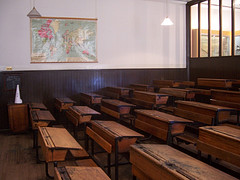
School desks by Alex Liivet (Flickr)
Ebonie’s mother challenged the use of the desk claiming that it violated her daughter’s Fourth Amendment right regarding “seizure” in that she was locked into the device. She also sued the school district on the basis of violating Ebonie’s rights under the Fourteenth Amendment regarding equal protection in being treated differently from her classmates. In August, 2012, a federal appeals court ruled in favor of the school district.*
The Tenth Circuit Court of Appeals held that “Physically binding a student is a much more significant imposition on her dignity and bodily integrity than the use of the desk in this case.” It distinguished Ebonie’s case from others where students were physically attached to desks by handcuffs or tape to restrain them. In those cases, courts have ruled that the actions amounted to “seizures” that are prohibited under the Fourth Amendment.
The Court in Ebonie’s case stated “We conclude that the desk’s limitation on Ebonie’s movement did not significantly exceed that inherent in everyday, compulsory attendance.” In other words, the position of the desk forced her to assume “seated in a chair faced forward is the standard pose required of countless schoolchildren across the nation.”
*Ebonie S. v. Pueblo School District No. 60, 2012 WestLaw 3667403.