

Does holding a public high school graduation ceremony in a church endorse religion?

As you know, the First Amendment states that “Congress shall make no law respecting an establishment of religion . . .” (ratified in 1791). This phrase is the basis of the principle of separation of church and state.
For the past ten years schools in the Hartford, Connecticut area, the school district has held their annual high school graduations at the First Cathedral Church in nearby Bloomfield. The Enfield School District explained that the church holds 3000 people and is an affordable venue for the ceremony. However, the event scheduled for June 23, 2010, cannot take place at the church.
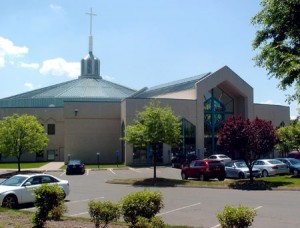
First Cathedral Church, Bloomfield, CT
Several students and their parents sued the school board to prevent the ceremony from being held in a church. They claimed that it would be an unconstitutional endorsement of religion. The school agreed to cover some of the religious symbols including crosses but that wasn’t acceptable to the court.
High school graduation is recognized as a significant event in a student’s life. Consequently, any action that forces a student to choose a religious belief or practice over attendance is unacceptable. Some religions view entering a church as a religious act, while others prohibit their members from entering a Christian church.
One of the students told the court that by attending his graduation in a church he would be forced to submit to a religious environment that would make him feel extremely uncomfortable and offended.
On May 31, 2010, a federal judge ruled* against the graduation being held at the church. She wrote that “. . . .holding graduations at First Cathedral not only can be viewed as coercing students to enter a church and support or participate in religion but can also be viewed as coercing the violation of one’s own religious beliefs.”
*Does 1,2,3,4 and 5 v. Enfield Public Schools (May, 2010).
Update: The same issue has come up in the state of Georgia. In January, 2011 the Cherokee County School Board voted not to move their graduation ceremonies from the First Baptist Church of Woodstock. Because of available space and the $2,000.00 fee, the church was chosen for all of the County’s ceremonies this year. A challenge is expected with possibly a similar result as in the Enfield case.
Do you agree with the court’s decision? Would you have any concern if your graduation was held in a place of worship not your or your family’s faith? What about in a synagogue, or mosque or a religious hall? Should religion even be a concern at a public high school graduation ceremony?
I mostly agree with this decision. Is there any discussion in the decision which would help understand if it was intended to apply to a situation at a private college (one which accepts Federal Financial Aid and claims to provide a non-sectarian education)?
I recall not attending my college “opening exercises” or any other events, or ever visiting, my college’s magnificent structure that is its cathedral. The tenets of my faith, as I understood them, prohibit me from entering such a place.
Was I denied full participation in the educational experience? Did I have a right to that?
Dear Robert: Not knowing all the facts of your situation and the facts & law applicable at the time, we cannot say whether there was a legal issue regarding your college. We attach here the opinion in the Ensfield case from May, 2010 for you to read. All the best.
[This is information only – not legal advice].