

Have you heard of the National Day of Prayer?

For over a half-century, the United States has recognized a National Day of Prayer. First established in 1952 by Congress, our presidents started in 1988 issuing a proclamation asking Americans to pray. The first Thursday in May has been designated as the National Day of Prayer.
As you know, the 45 words of the First Amendment include what is referred to as the “Establishment Clause.” It states that “Congress shall make no law respecting an establishment of religion . . .”
A group opposing the National Day of Prayer filed a lawsuit in 2008 against the federal government arguing that it violates the separation of church and state. The government’s response was that the day simply acknowledges the role of religion in the United States. One lawyer commented that a day set aside for prayer represents a time-honored tradition that embraces rather than violates the First Amendment.
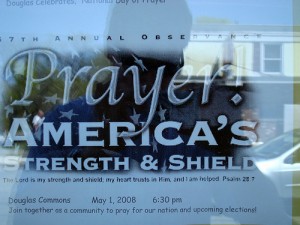
Photo by Svadilfari (Flickr)
In April, 2010, a federal judge in Wisconsin ruled that the National Day of Prayer was unconstitutional – that it amounted to a call for religious action. Judge Barbara Crabb wrote in her decision that the government can no more call for a day of prayer than it could encourage citizens to fast during Ramadan, attend a synagogue, or practice magic.
Do you think that the President of the United States in calling for a day of prayer crosses the line? Does it offend Americans who do not pray or believe in prayer? Or is it less of a religious endorsement than an American tradition? How do you define prayer – does that make a difference?
This is not likely the end of the case. Appeals to higher courts including the U.S. Supreme Court are possible.
Another tradition has taken a hit. It has been a practice of state legislative bodies to open each session with a prayer. In January, 2011, the state Senate in Hawaii voted to end the daily opening prayer, fearing a court challenge. Rather than attempt to create a non-sectarian, non-political invocation the Senate decided to do away with prayers altogether. This is believed to be the first state legislative body in the nation to halt the practice.
For more about teens’ rights at school, take a look at Do I Have To Pray At School?
if people want to pray on their own time fine. However, the president of the US represents ALL Americans, ones that pray, don’t pray, meditate…. whatever. Prayer is connected incredible strongly to religion (unless you’re talking Preying… which is violent.. ) so due to the seperation os church and state it would be inapproperate for the government to declare such a thing on behalf of all US citizens. Hope is good. Calling it prayer and using that term to represent all US citizens crosses the line.