

The Supreme Court begins its 2011-2012 term
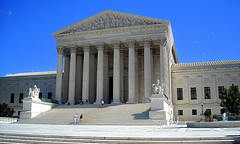
On Monday, October 3, 2011, the United States Supreme Court started its new term. Oral arguments are set for some cases this fall, while others will be heard during the spring session. Thousands of petitions for certiorari (review) were filed with the Court. Less than 100 cases will be heard by the Court this term. The average number over past years has been 75-80 cases per term.
Not all petitions for review have been ruled on. However, the Court denied this first week of the term two cases that would have had an affect on teen issues. The first involved an Illinois law requiring a daily period of silent prayer* or reflection. The law authorized schools to observe a moment for “silent prayer or for silent reflection on the anticipated activities of the day.” The lower federal court’s ruling remains in effect. In 2010, the 7th Circuit Court of Appeals said that there was a secular purpose behind the daily reflection: to calm students and prepare them for learning. The Court also declined without comment to hear a case involving a South Dakota special education* student who was placed in an alternative school for 38 days without a formal hearing. This left the ruling of the 8th Circuit Court of Appeals in place requiring the student’s parents to exhaust their remedies under the Individuals with Disabilities Education Act (IDEA) before resorting to filing a civil rights lawsuit.
There are a few cases that are expected to be set for argument affecting teens and families. One challenge concerns the rules of the Federal Communications Commission (FCC) regarding profanity on television when children are most likely to be watching: the so-called “family hour” before 10:00 p.m. Broadcast networks claim the rules are vague and outdated when the Internet and cable television aren’t regulated. The issue arose during several award shows when celebrities used profanities in their on-air comments. The FCC fined the networks who have fought the sanctions for years. The government argues that the airwaves during these hours should remain a safe-haven for children. For more on this issue, click here.
U.S. Supreme Court
Another issued expected to be addressed by the nine justices on the Court regards the use of global positioning systems (GPS) by the police. The question is whether law enforcement can place a GPS on a vehicle of a suspected drug dealer without court authority. Lower courts have ruled that a warrant is not necessary since drivers have no reasonable expectation of privacy while traveling on a public road or highway. Other courts have disagreed. A decision will affect teen drivers engaged in drug transactions.
A third issue that may be accepted for argument regards illegal immigration and state laws passed in Alabama and Arizona. The federal government sued Alabama claiming that control of the nation’s borders is exclusively a power of the federal government. In Arizona, the most egregious parts of the law have been put on hold until the Court settles the issues.
Finally, student free speech on the Internet is another issue the Court may rule on. For a review of the cases that may end up being decided by the Supreme Court, click here.
We will keep you posted on developments in these cases.
*Sherman v. Koch, USSC October 3, 2011, Case No. 10-1191.
** Doe v. Todd County School District, USSC, October 3, 2011 Case No. 10-1411.
As an uncle of two little boys who watch a lot of tv during the evening hours, I would greatly appreciate the FCC clarifying their rules against profanity – it will be interesting to see how the Supreme Court rules on that one.