

When can my school discipline me? What is corporal punishment?
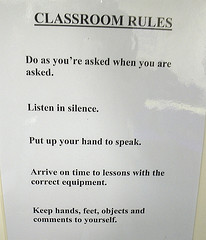
At the beginning of the school year, you may be given a copy of the school′s rules regarding what′s expected and the consequences for noncompliance. When you break a school rule, you may face civil or criminal action or both.
Civil action, in the context of school behavior, means the school may discipline you. It can′t lock you up or give you a criminal record, but the consequences may include suspension or expulsion.
If what you did also violates the criminal laws of your state, you may be charged with a crime (or delinquent act). This means you′ll have to go to court and may end up on probation. This may seem unfair, since you get punished by the school and again by the court. But this has been determined appropriate, with no violation of your constitutional right against double jeopardy (double punishment for the same offense).
Photo by Jem (Flickr)
If you′re sent home, suspended, or expelled for disruptive behavior, your parents will be notified. You′re entitled to due process, meaning you have a right to be heard. You and your parents may meet with the principal to discuss your behavior and the consequences the school has imposed. This doesn′t happen for every infraction—usually only those that carry serious penalties and inclusion in your school record. You may also be entitled to a hearing.
What is corporal punishment?
“The use of corporal punishment in this country as a means of disciplining school children dates back to the colonial period. . . . Teachers may impose reasonable but not excessive force to discipline a child.”
—U.S. Supreme Court in Ingraham v. Wright (1977)
Corporal punishment (swats or paddling) may be permissible in your school, as long as it′s not excessive. Physical discipline isn′t prohibited by the U.S. Constitution, but it may be limited by state law or school policy. A reasonable amount of force may be used by school officials to break up fights, prevent damage to the school, take weapons from a student, or act in self-defense.
States that allow corporal punishment
Click here to see which states are still paddling students and how many students receive corporal punishment in that state during the school year. In March, 2011, New Mexico banned the practice in schools. Some states, Texas and North Carolina, for example, give parents the choice of opting out their children from corporal punishment.
Update: A study released in August, 2008 reported that there were 223,000 incidents in U.S. public schools during the 2006-2007 school year where students were paddled or swatted. These occurred in the states that still allow corporal punishment at school (Human Rigths Watch and ACLU).
A report in 2016 from the federal government’s Civil Rights Data Collection indicates the during the 2011-2012 school year, approximately 163,000 children were subject to corporal punishment. Nineteen states still allow physical discipline including Alabama, Arkansas, Arizona, Colorado, Florida, Georgia, Idaho, Indiana, Kansas, Kentucky, Louisiana, Missouri, Mississippi, North and South Carolina, Oklahoma, Tennessee, Texas and Wyoming. This is a decline in total numbers over the past three decades.
Courts use the following test to determine if the discipline used at school was reasonable and not cruel or excessive:
• the student′s age and maturity
• the student′s past behavior
• the instrument used for discipline
• the motivation of the disciplinarian
• the availability of less severe discipline options.
A federal court suggested the following guidelines for school authorities using corporal punishment:
• Students must be given advance notice as to what behavior merits corporal punishment.
• Corporal punishment must not be used for a first offense.
• A second school official must be present when the punishment is carried out.
• A written statement about the incident, punishment, and witnesses must be given to the parent.
It′s against the law to insult or abuse your teacher. Because of their special position in the community, teachers are given extra protection under the law. Hitting a teacher is a serious crime (aggravated assault) and carries an increased penalty, including probation, community service hours, fines, and/or time in detention or a state juvenile institution.
School officials are authorized to discipline students for swearing or making obscene statements or gestures. Although you have the right of free expression, it′s not without bounds. The U.S. Supreme Court has held that if your activity is “materially and substantially” disruptive to normal school functions, or if you infringe upon the rights of others, restrictions may be imposed. Students should respect all school personnel and expect their respect in return.
Unless you′re a student, you may not be permitted on school grounds or in a classroom without permission. Interfering with a class may result in charges and penalties for disorderly conduct and trespassing.
He who opens a school door, closes a prison.” -Victor Hugo, French writer and poet (Les Miserables (1862) and The Hunchback of Notre Dame (1831)).
Judge Tom discusses the legality of corporal punishment and the state laws that allow teachers to use physical discipline against students.

if i bring a knife to school along with this other kid, is it legal for the principal to suspend me for 4 days, give me 3 weeks of issp, than a hearing, than permanetly disenroll me in the state of Florida?
Dear Dominick: Take a look at your Student Handbook for the rules regarding “zero tolerance policies” and weapons and drugs. Most schools have strict rules about bringing these items on campus even if they’re toys or replicas. Here are some examples to give you an idea of what’s happened around the country. Good luck.
(This is information only – not legal advice).
I have a question:
What happens if a teacher ignores a medical emergency?
Dear Veronique: Teachers and all school personnel have certain responsibilities regarding the students in their care. If a teacher is aware of a situation and takes action or looks the other way, there may be consequences. You would have to look to the laws in your state to see what is stated about the relationship between teacher and student. Discuss this with your parents. If may be helpful to schedule a meeting with the principal to discuss what happened. Good luck.
(This is information only – not legal advice).
well i skateboard and in my school there are only 3 others that do too, so one day in class we have to write a group paper describing something and the people in my group don’t skateboard and we described a skateboard and she gave me an 80 (which is a C here) on a quiz grade and the reason i got an 80 is because she said on the back of the paper “i dont believe everyone knew about your skateboard devon!” i tried to tell her they did but she would not listen, is she breaking the rules?
Dear Devon: Other than possibly impatience or disbelief in the genuineness of your topic, your teacher didn’t break any known rules. Make sure you fully understand your next assignment in order to avoid another encounter with her of this type. Good luck.
[This is information only – not legal advice].
Corporal punishment in schools: economic, legal, practical, ethical or constitutional?
Economic: internet discussions on corporal punishment are replete with parents relating how they intended to move to a particular locale only to learn the school systems physically punished children there and switched to safer area.
In the now famous TV episode an otherwise progressive principal delivers gasp producing paddle blows to not especially disobedient kids; somewhere on line last summer I read an elementary school handbook (cannot to track it down now – changed under public attention?) that required younger children to carry demerit on their person and prescribed they would be paddled for even one lateness, as if they had gone over the limit, if they lost their card; a former Booneville, Arkansas special education teacher is now suing in federal court for not having her contract renewed over refusal to beat autistic children.
What educated, progressive parent (the kind every community works hard to attract) would move their children to a locality with such systematically callous school punishments? * And the more corporal punishment dies out the more objectionable it can seem to the rest of parents wherever it is left.
****** ******
Legally liable: according to a Booneville school handbook that I also read on line a student will be advised in person that the next infraction may result in corporal punishment — if they are about reach their quota. The federal court rule is that schools must follow published rules for corporal punishment — to fit under what I call the “exception” to normal state prohibitions against assault.
This should make any step outside the published rules a step into criminal assault culpability – in easy reach of law suits, even if not likely to see prosecution.
The boy in the TV episode made all his tardy infractions in one day (had a silly day escorting a girl too far to her class before trying to make it on time to his own class). There is no way he could have been warned before the last infraction because the administration could not have known in time.
The class president girl may not have been warned personally before her last tardy either. She picked Saturday school for once (with the half-day off corporal punishment option) because she was sick on the regular detention school day. Nobody may have thought she would need the warning – just speculation on both; but they illustrate the easy legal slip up potential I am warning of. **
Beating younger kids for a lone infraction because they do not have their infraction card in their possession could plausibly be seen by a court as beating a child for no real infraction (normal expectation should be a number of lost cards a school year); even parents may not legally hit for nothing) – you never know how courts will see things until you get to court.
****** ******
Practical: concealed psychological trauma. Cops and psychiatrists can tell you there are a lot more damaged individuals around than psychologically naive school teachers and administrators might ever guess – cops because they deal with such folks and the problems they cause all day long. I don’t know how much shrinks really know about what goes on in patients’ heads or what to do about it but they see nothing but such problems all day long.
Paranoids (potential serious alcohol abusers and heroin addicts) fail to perform tasks because in their super-self conscious state they do everything to satisfy others – never for their own satisfaction; robbing them of the satisfaction of accomplishment. Substances liberate them from we “heavy supervisors” so they can normal gratifications (the real addiction). To use hold’em poker nomenclature: a kid who perpetually fails to do homework or show up on time may reasonably be put on a paranoid hand. Last thing in the world you want to give such is violent beatings.
Kids who don’t care about themselves because they perceive (about half the time incorrectly) that nobody adult cares about them is the classic description of a juvenile delinquent (talking robbery and burglary) — more out of their own control than anything else. Boys are in the emotionally dependent stage until 18 1/2 and are very prone to this level of what I call hysterical alienation (dependence switch off seems to come over about a weeks time in my observation); girls mature a year or year and half earlier. More wrong candidates for adult beatings.
Girls who think take paddling as sexual abuse (maybe even with female paddlers and witnesses) are another no-no category (striped much more invasive stripped?). Kids who formerly lived where corporal punishment was out of the question often take it (subjectively) as the most violent of personal insults (parents too!) – even some kids who aren’t new to it (striped more outrageous than stripped? — how many hate teachers all their grown lives for “over quick” punishments?”). *** In poker terms we are building up a lot of inside straight and three-flush draws; not one thousandth of one percent stuff — and I do not even have professional training to make up a comprehensive list; just reporting what I have seen in my personal 65 years.
And we haven’t even gotten to teachers with bad motives. One out of 14 Catholic priests has been accused of molesting children (incurable molesting does not come from the strain of celibacy – it is better to marry than to molest – these guys brought their problems to the seminary with them). How many teachers have some interest in seeing their own or opposite sex children bend over? How many are just plain mean (“many are called but few are chosen” applies everywhere) – or just neurotic – or something else this nonprofessional cannot conjure up (or all of the above)? More gut shot draws adding up.
First to no harm: given all the potential serious harm of school beatings — if they are optional to the student, therefore admittedly not needed by the school – there is no excuse to continue the practice. Even students who are never struck complain of “living their school years in fear”: yet another developmental risk.
****** ******
Ethical: the way our emotions work (the way our innate — limbic system – emotions are wired – not talking forebrain intelligence) we cannot inflict violent pain as a punishment (on adult or child) unless we perceive a significant moral offense. If this is true all I have to do it talk any school paddler into seeing school infractions are not morally offensive, more like being inefficient, and they should not be able to hit kids.
Tough assignment: I can come up with many midbrain (limbic) equivalents to support my story but not yet a direct forebrain description or definition (example of: fetuses do not get equal respect because we are not wired to think in terms of a personal identity for an individual unborn child).
Would most people who heard of the infractions of the two kids on the TV episode them significantly immoral? If our high minded principal’s own kids were guilty of the equivalent “inefficiencies” at home I am confident he would feel it immoral to correct them with a terribly painful beating (over one silly day’s two-minute latenesses?). What is the emotional difference?
A horror story on one forum (unlike the more normal “laboratory” of Bonneville High) is of a principal paddling five kids whose car pool ride ran out of gas and who pushed the car the rest of the way in to school. Most would probably not see any big legal objection to all five serving detention but I believe most people would see it as outright illegal (and immoral!) to violently beat them over an empty gas tank that was no way their fault. Why the difference?
Most who might maintain that a kid being late for school is significantly immoral would not carry the same moral judgment over to lateness on the part college kids or adults; especially about a couple of minutes late every couple of weeks (20 times a school year! — like I used to be in high school; no such “outrage” in my few months in college though; college was more interesting). Why?
Is it natural for our emotions to see kids infractions as uniquely immoral? Or is it natural to feel we can beat only children for infractions that are not significantly immoral? Being a male of the species who evolved primarily to swing a bat on meat I would have no problem personally paddling kids if only I could see their little office management inefficiencies as morally offensive (if only I could forget that kids who mess up the most are most likely to be emotionally messed up the most; a teacher can never tell).
****** ******
Constitutional: Admitted lack of necessity for school systems to use corporal — admitted because the option is supposedly given to student (supposedly because outside circumstances often force the option against their will) is the easiest argument that physically beating violates 14th Amendment based equal protection of the law (against physically beating except in self defense).
The Equal Protection Clause was put in place to insure that 13th Amendment freed African Americans would not be treated as second-class citizens. Now children at school or home are the only class of persons exempted from normal criminal law protection against being painfully beaten with the paddle invented to torture slaves – while still sending them right back to labor.
There are two compelling motives that I know for exempting children at home from equal protection – neither of which has the slightest bearing on school administration:
First: keeping crackpot government rules and employees out of the familial sanctuary. Schools usually are the government – at least they are not the home.
Second – very esoteric psychological: children who get out of control of parents think nobody cares about them, don’t care about themselves (very strange, very true and very devastating) and become easy prey to every street temptation (talking robbery and burglary!). Boys remain fully in the emotionally dependent stage all the way until 18 1/2 (switches off over a week in my observation). Better for them to be beaten at home than to get totally out of (their own) control and end up behind bars – better for everyone else too. Teachers cannot have a supportive relationship with 25 or 500 kids.
If many equally situated schools admit no need for corporal punishment then the burden should be on schools which inflict on it’s kids what would be a serious criminal act on anyone else (e.g., adult convicts) to prove a compelling need. As I said above, schools that make it optional for students have no compelling interest case to make at all.
Fundamental right to equal protection against unbearably painful beatings = compelling interest needed to override this right. Roe v. Wade established this balancing precedent – the compelling interest test — for the Due Process Clause of the 14th Amendment. *
PS. If special education students receive corporal punishment disproportionately, as is widely reported — even though most all administrations would probably want to go easier on them — that just proves their misbehavior is related to their developmental difficulties and therefore they should never be be beaten for it. (PPS. As suggested in section three, a disproportionate amount of school misbehavior may be linked to — guess what? — home grown behavioral impediments.)
[ * Roe v. Wade side-stepped possible human life at any stage (admitted “judiciary is not in a position to determine when life begins”) which looks like a compelling state interest if ever there was one – switched off to “may not by adopting one theory of life override the rights”: a never heard of before or since “consensus test.” Hint: medical consensus — one week under which we find what Roe was hiding from.]
* a few examples: http://www.corpun.com/uss00303.htm#10956
* endless examples: http://www.corpun.com/usscr2.htm
* outrageous example + sensible observation:
http://www.greatschools.net/find-a-school/school-visit/how-safe-is-your-school.gs?content=6
“My 1st grade son’s bruises lasted 12 days. He was paddled for picking his nose. ”
“When adults hit children and bruise them, the system says it was in the name of discipline. Yet these same teachers are mandated by law to report bruises on these school children if parental abuse is suspected.”
** all-in-one example: http://www.nospank.net/n-j96.htm
*** “revolting” example: http://www.youtube.com/watch?v=6OLv4Q9Tebg&feature=related
Thank you for your thoughts and comments Denis.
[This is information ony – not legal advice.]