

What are the penalties for drinking and driving?
Automobile accidents are the top killer of teens in the U.S., with 42 percent of the accidents due to alcohol. There are different tickets involved in an alcohol-related incident: one for driving while intoxicated (DWI) and another for driving under the influence (DUI).
If you′re stopped by the police, you may be asked to take a test to check the alcohol level in your blood. Remember that when you apply for a driver′s license, you automatically agree to being tested upon request for your blood-alcohol level. If you refuse to take the test, your license may be suspended or revoked.
Photo by Barely Fitz
The test given may be a field sobriety test involving physical exercises at the scene to determine your physical state—touching your nose, picking up a coin while standing on one foot, etc. The officer may also check your eyes for dilation or rapid movements. Or you may be asked to take a breath or blood test. Either of these gives a reading indicating your level of sobriety.
If your blood-alcohol level is under the state′s legal limit (for example, .08 or .10), you may be cited for driving under the influence. If your level is at or over the limit, you′ll receive a ticket for driving while intoxicated.
The penalties for underage drinking and driving are serious and are becoming even more strict across the nation. Loss of your driver′s license for a period of time is common practice, while substantial jail time is imposed for second and subsequent offenses. You′ll also notice a significant increase in your car insurance. A DUI or DWI stays on your record for years. Your insurance agent can give you the specifics under your state′s laws.
A few states have implemented strict consequences for repeat offenders. South Dakota, for example, has a 24/7 Sobriety Project where persons who reoffend are forced to stop drinking for at least three months. They must take two police-observed breathalyzer tests every day and pay the $1.00 fee for each. If they fail the test, refuse to take it or don’t show up, it’s an immediate one day in jail with increasing consequences. In 2008, drunk-driving fatalities in South Dakota fell to 34, down from the national average of 70. Other states and the City of London are considering similar programs.
Related offenses cover such incidents as having an open beer or wine bottle in your car, soliciting someone to buy alcohol for you, and buying alcohol for a minor. All carry stiff penalties with far-reaching effects.
A fairly new crime involves the use of cellphones and texting while driving. A few states [Washington and California] already prohibit this with at least a dozen other states considering new legislation. Fines run from $20.00 per violation to hundreds of dollars. TWD [texting while driving] is getting a lot of attention due to traffic deaths across the country.
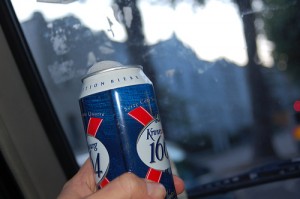
Photo by Todd Huffman
Most states also have an Open Container Law which prohibits the possession and consumption of alcohol in vehicles. The law applies to drivers and passengers as well as any area of the car where a passenger can sit. So, even if you’re driving alone and have an open beer can or bottle behind your seat, it’s illegal. Check with local law enforcement to see if your state has an Open Container Law.
Update: In September, 2009, Canada imposed its first life sentence on a DUI offender. Roger Walsh, 57, had 19 impaired driver violations including one death in 2008 after a night of drinking. Canada abolished the death penalty in 1976.
A study in 2016 by personal finance site, Wallet Hub, indicated that Arizona ranks number one in with the toughest criminal penalties for a DUI, and number two in the country for DUI prevention efforts. First-time offenders are required to spend ten days in jail, with an opportunity to serve only one day if they successfully complete a probation period. A fine of $1,250.00 is also imposed, and a ninety-day driver’s license suspension. After the ninety days, and for the next year, the driver must have installed and pay for an interlock breath analyzer system in order to start the car. Anyone convicted of more than two DUIs commits a felony and must serve a minimum of four months in prison.

Hi, just got arrested last night and I got a DUI, and tickets for possesion of weed, and aderal. I blew a 1.3. What is the worst that could happen to me? How long is my license going to be suspended?
Dear Brooke: The consequences you face depend on the specific DUI and drug laws of your state, but generally include fines, possible jail time, counseling and/or educational classes and suspension of your driver’s license (anywhere from a few months and up to a year or so). Try Googling the name of your state and “first offense DUI penalties.” Also, you will find out more about your options and the possible penalties when you appear for your first court date. Good luck.
(This is information only – not legal advice.)
My fiance was court ordered to serve 10 days of community service, take m.a.d.d class and a drivers education class and a fine as a punishment for a d.w.I . That has happened a year ago. He can no longer drive for his company he is currently working for . By no driving there is no way to move up in positions. It is really the companies insurance which wont let him drive. But it is affecting his life, family, and his childrens life as well as mine. If he could get the charges lowered to a traffic violation since he has donw what the court has asked, then things would look up in a multiple number of ways. Do you thinks there is any chance a judge would do this? And if so how do we go about doing it or asking?
Dear Megan: We suggest that your fiance speak with a defense lawyer about this. States take DWIs seriously as he has learned. Your state’s law may allow a conviction for DWI to be reduced at some point in the legal process. He could also ask at work what is needed on his record to be able to move up with the company. For example, if he gets his record cleared or expunged, will that open the way for future promotions. Some defense lawyers offer a free consultation for the first 30 minutes or so. He should ask about this if he calls one. Good luck.
(This is information only – not legal advice).
My friends husband has a jeep.She found a open bottle of alcohol in the back of the jeep. When she confronted him he said the police couldn’t do anything about it because it was in the back. True or not?
Judge Tom’s response:
Good question. The answer depends on whether your state has an Open Container Law and what it says. In 1998, Congress pass a law against the possession and consumption of alcohol in vehicles [23 U.S.C.A. 154]. The law is tied to federal transportation funds which states can receive once they create their own open container law. Most states have complied. It includes all passengers, not just the driver, and anywhere in the car/truck where a passenger could sit, whether present in the car or not. So, an open bottle or can behind the driver’s seat but in a passenger area would violate the law. Check with local law enforcement to see if your state has an Open Container Law. Our best regards.