

Do I have complete freedom of expression in school?
Although students have First Amendment rights in the school setting, no one, whether a juvenile or adult (student or not), has complete freedom of expression without some limits. The government may place reasonable restrictions on our freedoms. For example, city laws about loud noise at night, dancing in the street, or trespassing after hours in a park have all been found constitutional.
Likewise, students and teachers aren′t free to do anything they choose in the name of free speech or expression. Consider this example from Hazelwood School District v. Kuhlmeier,* the 1988 Supreme Court decision:
My father “wasn′t spending enough time with my mom, my sister, and I” before the divorce—he “was always out of town on business or out late playing cards with the guys” and “always argued about everything.”
These statements are from a high school journalism class about the impact of divorce. Other class articles covered teen pregnancy, sexual activity, and birth control. They were scheduled to be printed in the school newspaper. The principal, thinking that using the student′s name in the quoted passage would offend her parents, and that the pregnant teens could be easily identified, withheld the stories from publication. A lawsuit was filed by the newspaper staff, claiming a violation of their First Amendment freedom of expression.
What do you think? Should the stories have been printed? Should there be a limit on what goes into your school newspaper?
The court ruled that since the paper wasn′t a forum for public expression, but would be publicly distributed, the school could exercise control over its content. Teachers are charged with seeing that student activities and personal expression at school are consistent with educational objectives. Offensive, vulgar, or racist expressions may be censored in print, in campaign speeches, and in theater productions.
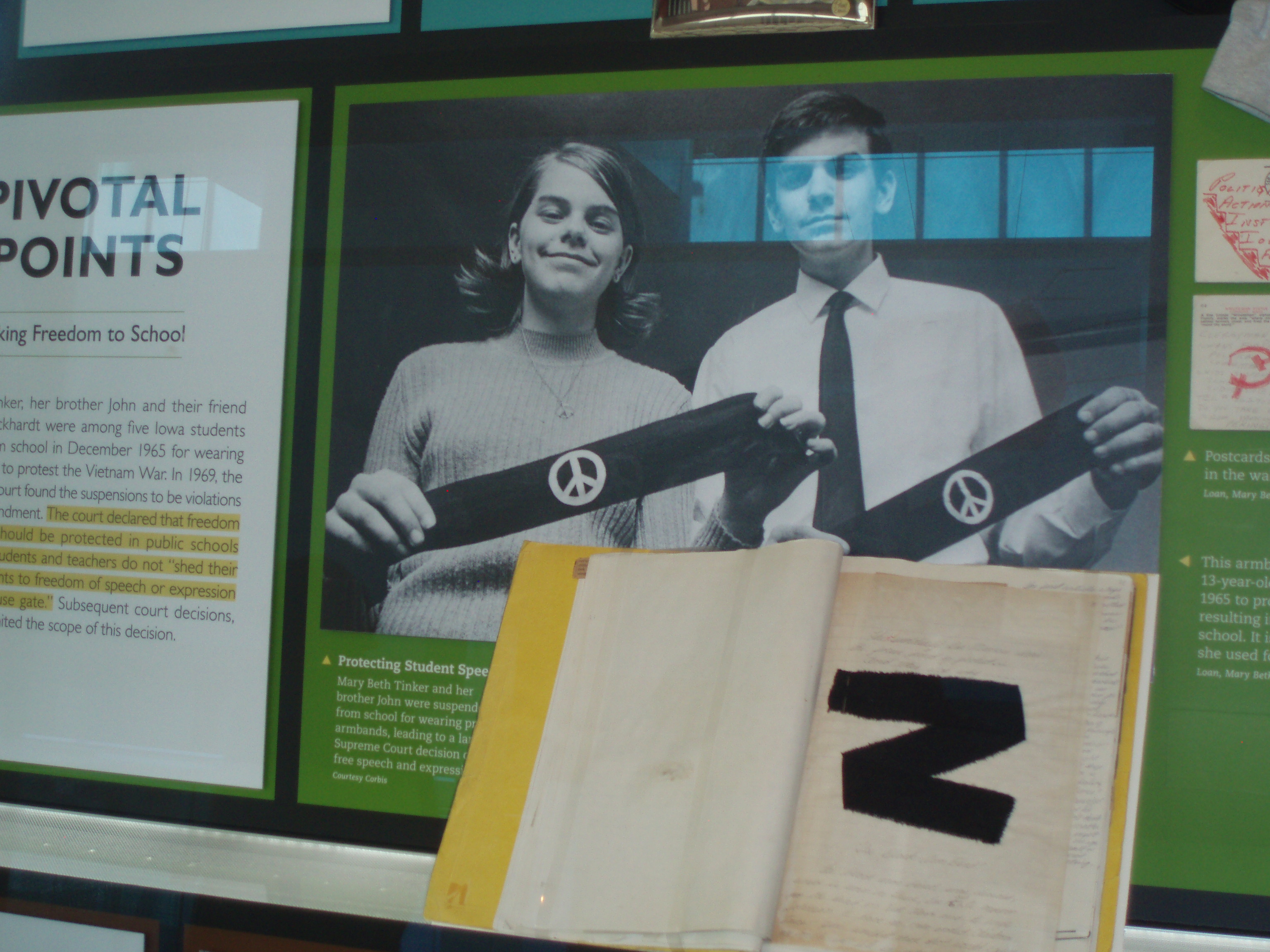
Mary Beth and John Tinker
“Students and teachers do not shed their constitutional rights to freedom of speech or expression at the schoolhouse gate.”
— U.S. Supreme Court in Tinker v. Des Moines Independent School District (1969)
In a 1996 case, the court spoke of balancing a school′s interest in prohibiting profanity with a teacher′s interest in using a certain method of teaching creative writing. Cecilia Lacks was a tenured teacher who taught English and journalism at a Missouri high school. One of her assignments was to write and perform short plays. The classroom productions were taped by a school employee. Upon viewing six of the plays and reading two of the students′ poems, the school board found that they contained “extensive profanity,” which violated school rules. They fired the creative writing teacher. She sued the school district for reinstatement and back wages—and she won.
The court recognized that schools have broad authority to prohibit student profanity. It further stated that it′s appropriate to consider the age and sophistication of the students, the relationship between the teaching method and educational objective, and the context and manner of the presentation. Because the context of the offensive language was part of a valid educational objective and not publicly distributed, the court decided it was improper to terminate the teacher.
But the court also wrote,“A school must be able to set high standards for the student speech” that is generated at school. Schools may censor expression that is “poorly written . . . biased or prejudiced, vulgar or profane, or unsuitable for immature audiences.”
*Hazelwood School District v. Kuhlmeier, 484 U.S. 260 (1988).
Read more about Cathy Kuhlmeier and her classmates who challenged the principal’s censorship of their work on the school newspaper in “Teens Take It To Court [Young People Who Challenged the Law and Changed Your Life]” by Free Spirit Publishing (2006).
Find out more about the landmark Tinker case and the 2007 Supreme Court decision regarding Alaska senior Frederick Morse his poster “BONG HiTS 4 JESUS.” In February, 2009, it was the 40th anniversary of the Tinker decision with a program that included interviews with Mary Beth Tinker. Watch this video about the Tinker case and how it has affected students’ free speech rights for the past 40 years.
Update on effect of Hazelwood: In February, 2008, the U.S. Supreme Court refused to review a California case regarding newspaper censorship. Andrew Smith was 18 when he wrote a column about immigration for his school’s paper, The Buzz. The article resulted in a protest at school, seizure of the remaining copies of the paper, and a letter of apology from the principal to the parents.
Andrew sued the school district for violating his free speech rights. The court determined that Andrew’s rights had been violated. Under California’s education code, students have freedom of expression except when it is obscene, libelous or slanderous, or substantially disruptive or incites unlawful acts. [see Smith v. Novato U.S.D., 2007 WL 1464617 and 2008 WL 432621].
In another incident, a construction worker yelled to a passing lady “How do you like your eggs? Scrambled, over easy, or fertilized?” This was one of several objectionable lines in “Catcalls,” a one-act play by senior Peter Keahey at Yellow Springs High Schol in Ohio. The school’s One Acts were written and directed by the students for a fundraiser in February, 2008. Peter was asked to change the lines but didn’t have time and preferred not to. One Acts had one less.
In February, 2008, senior Megan Estes, editor of The Elk, the school yearbook at Burleson High School in Texas, was instructed to edit a story about a student who was a teen mother. The intent of telling Brittani Shipman’s story was to show how her life had changed and how she was coping with motherhood. Brittani agreed with the story being told in The Elk. The principal censored it because it “glamorized” premarital sex and violated the school’s policy on abstinence.

In June, 2008 the Shasta High School newspaper in California, The Volcano, featured this picture and an editorial about the principle of free speech. As you can see the flag is burning – the article read in part “. . . to burn the flag is the penultimate embodiment of the tolerance America has towards . . free speech. . . The day an American cannot burn the flag, the day he cannot denounce his country, is the day America is no longer free.”
The school principal was offended and announced that the paper would be eliminated when school resumed in September. It may have been cut anyway due to budget constraints but this last issue of the school year clinched it for Principal Woollard. The school superintendent, a Vietnam veteran, was also offended but understood the need to keep the paper going. He announced two days later that the newspaper would remain at the school. California law prohibits censorship of student newspapers unless they contain material that is obscene, libelous, or likely to incite students to break the law or disrupt the school.
In 1989, the U.S. Supreme Court ruled in Texas v. Johnson (491 U.S. 397) that burning the American flag was protected speech and that a demonstrator could not be criminally prosecuted. In two earlier Supreme Court cases, the alteration and desecration of the American flag was determined to be symbolic speech and, as such, protected under the First Amendment. In one case (Smith v. Goguen, 1974) a teenager wore an American flag patch on the seat of his jeans. Valarie Goguen was prosecuted, found guilty by a jury and sentenced to six months in prison. In Spence v. Washington (1974) Harold Spence flew the American flag upside down in his apartment window with a peace symbol taped on it. He was also coinvicted and sentenced to a fine and ten days in jail. In both cases the convictions were reversed.
In September, 2008, a federal court in Arkansas supported the rights of Watson Chapel Junior High students who protested their school’s dress code. The court said they had a right to speak under the First Amendment. Chris Lowry, Colton Dougan and Michael Joseph wore black armbands to school as a silent protest against the school’s uniform policy. They were disciplined by the administration and, with their parents, decided to fight the school’s action. On March 2, 2009, The U.S. Supreme Court declined to hear the case which means it is over – the lower court’s decision in favor of the boys remains in effect. [see Lowry v. Watson Chapel School District, 8th U.S. Circuit Court of Appeals, 9/2/08]

Amelia Robbins
In August, 2008, 12-year-old Amelia Robbins started the 7th-grade at Mountain Grove Middle School in Missouri. When she was six, her father died of cancer and in his honor she died her hair pink with her mother’s permission. Amelia is an A-student who simply wants to express herself in this manner. The Student Handbook prohibits any dress or style that distracts others at school. She was suspended and sent home until she gets rid of her pink hair. She wants to return to school but is willing to stand up for her right to express herself. Amelia doesn’t think she should have to change her hair “because I’m expressing myself as an individual, because they constantly tell us “be different, don’t follow the crowd.” Update: almost two weeks later, the school relented without comment and allowed Amelia to return to school, pink hair and all.
Update: In October, 2009, a 32-year-old Saudi Arabian man was sentenced to 5 years in prison and 1,000 lashes. His offense? Mazen Abdul-Jawad spoke publicly about his sexual experiences since age 14 and displayed some sex objects. He was being interviewed on a Lebanese radio show and the tape made its way to YouTube. Under Sharia, the strict version of Islamic law, such subjects are not to be talked about in public. His lawyer said they will appeal the decision.
In March, 2021*, the 4th Circuit Court of Appeals upheld a decision of an elementary school in South Carolina based on the 33-year old Hazelwood decision. A 4th grade class at Anderson Mill Elementary School in South Carolina was assigned to write an “essay to society” about any topic they chose. A ten-year-old student, identified as R.R.S., wrote about equality for LGBTQ individuals. It was meant to be included in the classroom essay booklet, with copies sent home for each family to read.
The essay written by R.R.S. read as follows:
The school’s principal determined that her essay was not age-appropriate and advised R.R.S., that it would not be included in the booklet. She submitted a second essay about bullying in general which was accepted. The mother of R.R.S. filed a lawsuit alleging a violation of her daughter’s First Amendment right to free speech. Eventually the school agreed to include both essays in the booklet, but by then the student’s mother asked that neither be included in the published booklet. A federal court decided the case in 2021 stating that excluding the essay by R.R.S. was not “viewpoint-based discrimination.” It was the general subject of LGBTQ rights addressed to fourth grade students that was the basis of the essay’s exclusion. “We conclude that Hazelwood allows educators to make viewpoint-based decisions about school-sponsored speech.”).
- Robertson v. Anderson Mill Elementary School, 2021 WL 786631 (4th Circuit, South Carolina 2021)

I think that it wasn’t a violation of their First Amendment freedom of expression because it was about someone else and it would hurt their feelings and the kids could have been arrested.
Thank you for your comment, Trevor.
I was in school and we were watching the morning announcements and I was giving my opinion about what the lunch menu was for today and my teacher said stop talking but I said I have the freedom of speech and she said no you don’t not during the announcements but I said yes I do. She wrote me up just for that is that fair?
Dear Massie: Your right to free speech isn’t absolute. That means you can’t just say anything, anytime you want. Society, including schools, have the authority to enforce rules that are designed to ensure a safe, non-disruptive learning environment. That includes being silent at certain times throughout the day. Otherwise, school officials can impose penalties such as getting written up.
(This is information only – not legal advice).
An 8th grade student was given a detention for talking to some classmates about his upcoming birthday party, asking if they were excited about coming to it. The teacher had asked him to stop as she was concerned about it hurting the feelings of someone who was not invited, and considered this bullying. The student was not addressing the boy who was not invited at all. Can a school really tell a student what he can or cannot speak to his friends about? This was a personal conversation between friends. This teacher also told the boy that he really should have invited this other student. How is that even any of her business?
Dear Tracy: It’s possible that if the teacher believed the conversation was somehow becoming disruptive by hurting other students or had the potential to cause a disruption in the classroom, that telling the student to stop or receive detention was necessary. First, check the Student Handbook to see what it says about student speech on campus. If there’s no clear answer about when teachers can/should intervene in situations like this one, perhaps the student and his parents should request a meeting with the school principal to discuss what happened. Many teachers and school administrators are so concerned about “bullying”, that sometimes they take action when maybe it’s not necessary. Good luck to the student.
(This is information only – not legal advice.)
ok my friends and i like wearing hat and hoodies nad my school dress code is that we cant cover our heads. could you explain how that doesnt infringe on our rights? and once i had a teacher that said that they would right us up if we talked about a fight that had happened in the school. is my teacher allowed to do that?
Dear Dawn: As to your first question about head coverings at school, as long as the rules don’t discriminate against a student or group of students, they are probably legal. Schools have the authority to require a dress code, even public schools, including uniforms if that’s what the school district decides for their students. The code becomes unlawful if, for example, it says boys can wear whatever they like to school while girls must wear a uniform. So, requiring that your head must be uncovered is okay if it applies to all students.
Freedom of speech is another issue that schools deal with on a daily basis. You do have the First Amendment’s protection of free speech, but it’s not absolute. You can’t say anything at anytime to anyone you like. There is a difference between protected and unprotected speech. Hate speech, for example, or actual threats of harm against another student, are not protected by the First Amendment. So, we can’t comment on what a teacher said without having the details of the incident, but we hope this little explanation helps clarify your rights. Good luck.
(This is information only – not legal advice).
I would like a further explanation on freedom of expression in school on the basis of dress code. The dress code states that there should be no head coverings of any type in the classroom. I have talked to the superintendent at my school about this and he said that is alright to have a hat or beanie on in the outside areas of the school just not in the classroom. I am also apart of a dual credit culinary class that requires us to have a hair net or a hat that has been deemed acceptable as part of the dress code for that class. I was following the dress code at the college where i take my dual credit class where i’m required to have my culinary hat on at all times in the kitchen and the class room. when i returned to the high school still wearing my hat from the class period before (following the dress code) i was outside, where it is still deemed appropriate for me to wear my hat, it was confiscated. I was wondering if there is any advice i could get for handling this situation where i feel like my freedom of expression has been violated unjustly after everything i have heard from the superintendent.
thank you for any advice you can give
Dear Nicholas: As you know, schools have the responsibility of keeping a safe and hostile-free environment. Consequently, dress codes in public schools are common. As long as they are consistently enforced with no discrimination against anyone based on religion, gender, race, etc. they are legal. What you point out are different dress codes at two different schools. Because they aren’t identical doesn’t mean one or the other is wrong or unlawful. It might be a hassle to think about each as you go back and forth for your classes, but it’s a minor inconvenience that you’ll have to put up with. Good luck.
(This is information only – not legal advice).
Ok, I’m doing a paper for english over dress code rights in school. I could really use some help, but it seems like every sight says the same thing. For me it seems like the school is more concerned with the way we look than with our education. Oh yea and not to metion I keep getting in trouble for expressing my self! WHY?!?! I read the dress code rules andI;pm not breaking any of them.
Dear Bree: If you’re not violating the dress code, then either your conduct, words or both are getting you in trouble. You ask “WHY?!?!” you’re disciplined for expressing yourself. Without knowing the details and circumstances, we can’t answer this. If you use profanity at school, that probably doesn’t go over too big. The school’s responsibility is to provide you with an education in a safe, hostile-free learning environment. If a student’s appearance is disruptive on campus, the school may take action so their mission can be accomplished. Good luck.
(This is information only – not legal advice).
Explain freedom of speech in school.
If a teacher accuses you of something, don’t you have the right to reply and defend yourself? But when you do, why is it that the teacher tells you that you have an attitude and not to talk back? Isn’t this unfair rights of speech?
And what about wearing a thin necklace (hidden under shirt) and a certain teacher tells you to take if off when other teachers don’t care and the necklace is small, hidden, insignificant to the other necklaces students like to wear OUTSIDE of their shirts? Isn’t this unfair rights to expressing yourself?
Dear Julie: You do have free speech rights at school but freedom of speech is not absolute for teens or adults. There are limits we all must follow. What you’re bringing up here is the manner of expressing yourself. If you respond to a teacher or administrator with an attitude or profanity, they can correct you or even take action if you cross the line and break a school rule. If you calmly defend or explain yourself, the situation won’t escalate. As far as your necklace, if wearing it violates the dress code, a teacher can call you on it. Just because some teachers look the other way doesn’t mean another teacher can’t ask you to comply with the code. We know this isn’t what you wanted to hear, but there will be rules throughout your life – some will be okay, others you may not like but have to follow if you care to get on with life with little stress or aggravation. Good luck.
(This is information only – not legal advice).
At school, we were doing a research paper in English class and my English teacher said we couldn’t do our paper on Micheal Jackson or Adolf Hitler. Is this legal? (I live in the state of Illinois).
That’s a great question, Ben. Generally, teachers have broad discretion in teaching methods and selecting appropriate topics for class discussion and writing. This teacher may have reached his or her limit on papers on these two well-known figures. We’re not aware of any laws governing subject matter for class assignments. You can always ask your teacher to explain the reasons for this rule. Good luck.
(This is information only – not legal advice).
well i think that free speech is an imporantaint right that allows you to show who you are. hell i would burn the flag too in today’s ecomomy